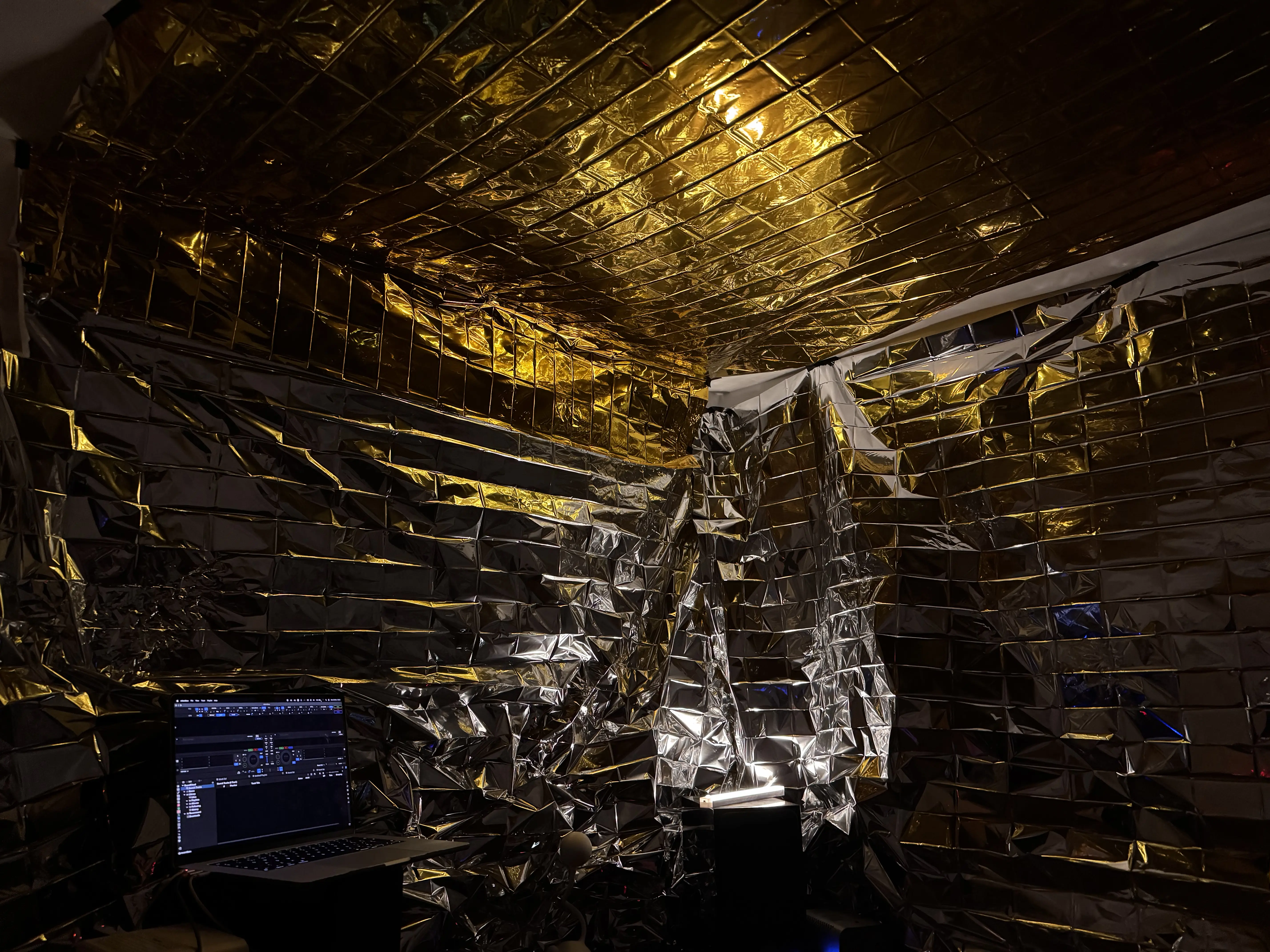
Experimentation with the use of emergency thermal blankets
as gold and silver reflective surfaces.
Venues containing lighting fixtures typically steer clear
of white walls, since they reflect the light that hits them.
This can make the room feel washed out, which detracts from
the intended lighting prior to reflection.
This experiment explored whether the reflection itself was
the issue, or if it was merely the diffusely reflective
nature of paint, which scatters light to fill any negative
space in the room, in turn reducing contrast.
Rather than reducing reflection by painting the walls
black, it was embraced by instead covering them with the
specularly reflective blankets. This resulted in more
controlled reflections, which scattered and refocused beam
lights into interesting patterns in the air around the surface.
The lightweight nature of the blankets also meant that the
reflections can be easily changed. Use of fans to move the
air around the blankets creates an automatically mutating
surface, which results in the patterns dancing through the
air.